MoFlo

Shipped: Feb 2026

Building a content execution system for SMBs

Building a content execution system for SMBs

Despite built-in AI generation and scheduling, SMBs weren’t producing enough content. Users viewed metrics but rarely acted. I redesigned the product from a creation tool into an execution system that proactively surfaced ready-to-approve drafts.

Despite built-in AI generation and scheduling, SMBs weren’t producing enough content. Users viewed metrics but rarely acted. I redesigned the product from a creation tool into an execution system that proactively surfaced ready-to-approve drafts.

Role

Product Designer

Team

Product Designer (Me)

CTO

Lead Developer

2 Front-end Interns

Timeline

August–December

2024

5 Weeks

Tools

Figma (Design, make, Jam)

Claude Code

Lottielab

V0

Figma (Design, make, Jam)

Claude Code

Fullstory

Platform Overview

Wait, what is

Wait, what is

?

?

MoFlo Cloud is an AI-powered content operations platform built for small and medium businesses (SMBs). It enables multi-platform publishing, AI-generated captions and visuals, scheduling, and performance insights, all within a single operational dashboard.

MoFlo Cloud is an AI-powered content operations platform built for small and medium businesses (SMBs). It enables multi-platform publishing, AI-generated captions and visuals, scheduling, and performance insights, all within a single operational dashboard.

The Problem

The Bottleneck Was Action

The Bottleneck Was Action

Customers were not consistent in creating content or translating performance KPIs into meaningful actions.

60%

Weekly Drop-Off

Activity consistently dropped at the start of each week, despite frequent dashboard visits.

1-2 Posts

Creation Fatigue

Most SMB users stopped after generating only a few posts per session.

<20%

KPI-Driven Actions

Few users created content directly from performance insights.

The Solution

Reframing MoFlo from a creation tool into an execution system.

Reframing MoFlo from a creation tool into an execution system.

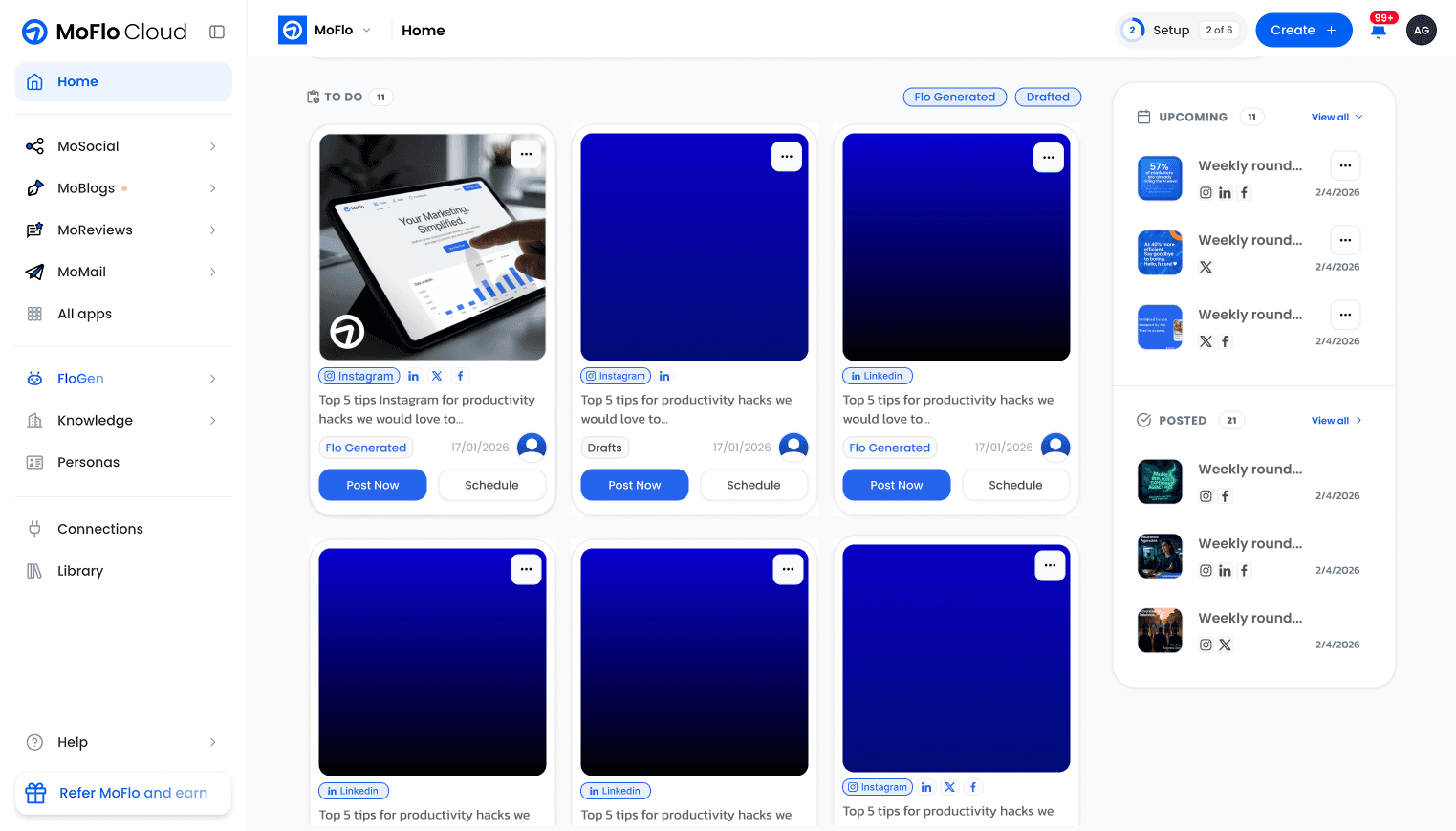
Instead of waiting for users to initiate content, the system proactively:

Detect Gaps Automatically

Operational signals surface what needs attention.
The system detects inactivity, runway gaps, and platform imbalance in real time.

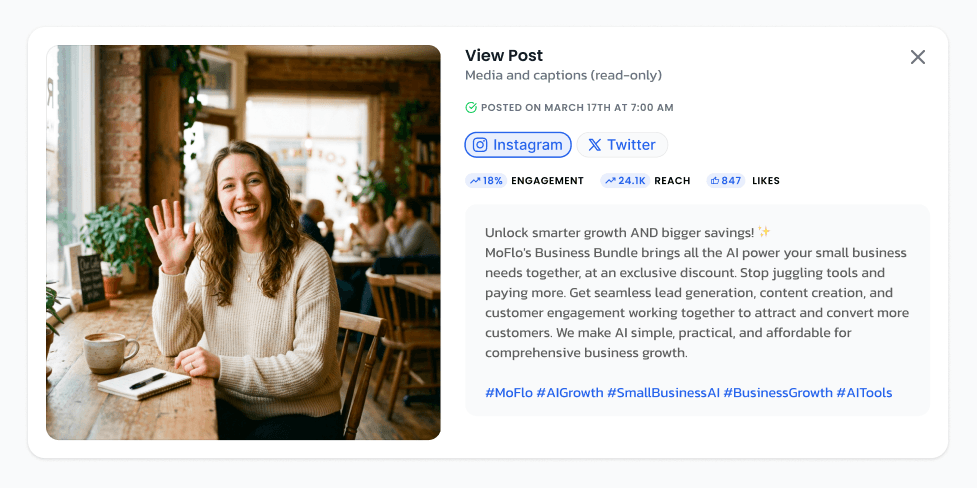
Review in One Unified View

See formatting across platforms before approval.
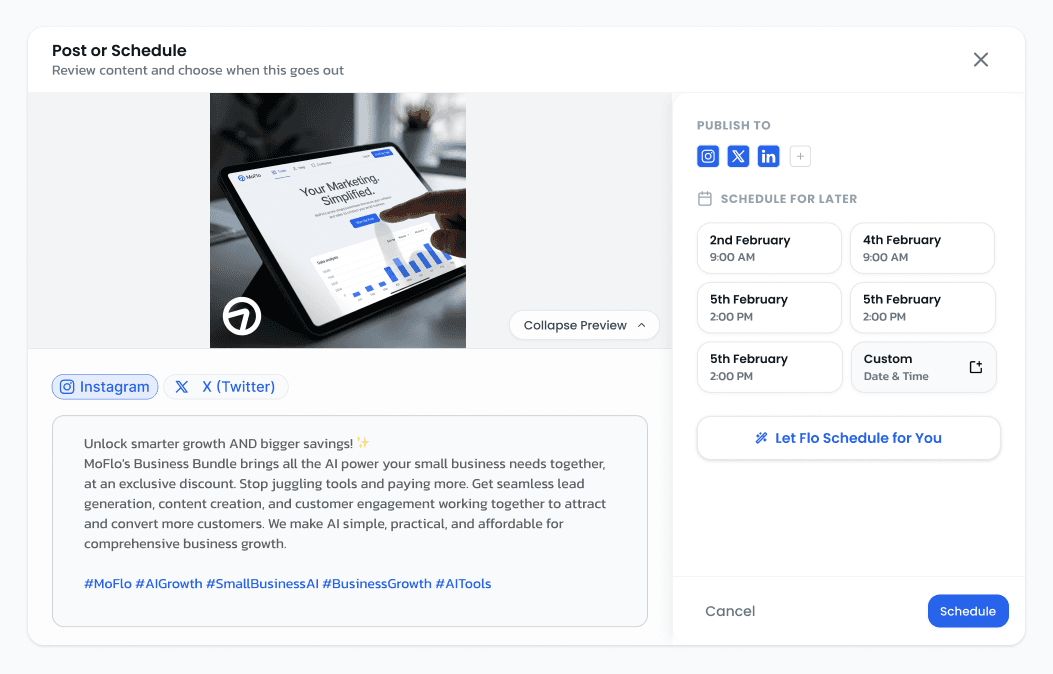
Instagram, LinkedIn, and X previews are visible in one place.

One-Click Scheduling

Approval triggers optimized scheduling.
No manual time selection required — Flo handles cadence.

Impact

Consistency improved when initiative wasn’t required.

Consistency improved when initiative wasn’t required.

Within one month:

60% 25%

Weekly Drop-Off

3X

Multi-platform publishing

~70%

Zero-edit approval rate

Users stopped planning content. They started maintaining it.

Existing Model

If the tools worked, why wasn’t content being made?

If the tools worked, why wasn’t content being made?

The product technically worked. Users could generate AI captions, visuals, and schedule across platforms. But behavior told a different story: weekly drop-offs were high, and content output remained low. SMB owners opened the dashboard but hesitated before creating. The gap was behavioral, not technical.

The product technically worked. Users could generate AI captions, visuals, and schedule across platforms. But behavior told a different story: weekly drop-offs were high, and content output remained low. SMB owners opened the dashboard but hesitated before creating. The gap was behavioral, not technical.

Step 1:

Step 1:

Generating a Caption

Generating a Caption

Step 2:

Step 2:

Generating an Image

Generating an Image

Step 3:

Step 3:

Scheduling

Scheduling

Initial Hypothesis

Maybe the generation experience just wasn’t good enough.

Maybe the generation experience just wasn’t good enough.

My first assumption was straightforward: users weren’t creating because the AI output wasn’t strong enough or the generation flow felt uninspiring.

Hypothesis:

The AI captions lacked quality.

Users needed more creative inspiration.

The generation flow required refinement.

If we improved the quality and usability of the creation experience, engagement should increase.

A Quick Experiment

I optimized the generation flow to test that assumption.

I optimized the generation flow to test that assumption.

Before re-architecting the system, I ran a focused improvement experiment.

I simplified the input experience, surfaced suggested topic prompts, and reduced friction in the generation UI to make starting feel easier.

Drop-off improved Slightly, but most users still stopped after generating 1–2 posts.

Activity consistently dropped at the start of each week, despite frequent dashboard visits.

Speaking with Users

I needed to understand how SMBs actually think about content.

I needed to understand how SMBs actually think about content.

Before making larger structural changes, I conducted user interviews with active SMB customers to understand how they approached content creation week to week.
I wanted to understand their mindset.

I asked:

  • How do you decide what to post?

  • When do you create content?

  • What happens when you open the dashboard?

  • What usually stops you from publishing?

What Users Said:

“It takes too much time to create and schedule a post. I just want someone to do all of it for me.”

“I open the dashboard, look at the numbers, and then close it.”

“It feels like I have to think too much before I can even start.”

“Every week it’s like starting from scratch again.”

A pattern became clear.

Content creation wasn’t part of a structured workflow for them.
It was something they did when they had time or when they felt pressure.

Several users described opening the dashboard, reviewing metrics, and then leaving without action. Not because they disliked the output, but because deciding what to do next felt mentally heavy.

For them, every week felt like starting from zero.

They didn’t lack tools.
They lacked momentum.

Key Insights

The friction was cognitive, not technical.

The friction was cognitive, not technical.

SMB owners weren’t avoiding content because it was difficult to write.

They were avoiding the repeated mental effort of:

Creation Was Competing With Real Work

The Workflow Didn’t Carry Momentum Forward

AI Helped Generate, But Not Execute

The Cost of Starting Was Too High

Reframing the Model

From Generation Tool to Execution System

From Generation Tool to Execution System

Existing Flow

Desirable Flow

I redesigned the flow around four shifts to reduce multiple steps into a single decision:

Gap Detection

The system identifies platform inactivity and content runway depletion.

Contextual Drafts

Drafts automatically appear in an approval queue, tailored to detected gaps.

Unified Cross-Platform Preview

Users see formatting across channels before approving.


One-Click Scheduling

Approval triggers automatic scheduling, reducing decision fatigue.

Design Process

Designing From User Friction

Designing From User Friction

Designing for momentum, not features. Once I reframed MoFlo from a generation tool to an execution system, the next challenge was structural:

Where does decision-making actually live?

Breaking the “Generate → Schedule” Loop

My earliest sketches explored separating content by status:

  • To Do

  • In Progress

  • Completed


Instead of a flat dashboard, I experimented with a pipeline model that made work visible across stages.

Goal: Make content feel like committed work, not optional drafts.


But something felt off.

Users still had to decide what to do first.

The system wasn’t decisive yet.

Exploring a KPI-Driven Dashboard

Next, I experimented with a metric-forward layout.


Insights at the top.
Generated content below.
Calendar to the side.


The idea:
Metrics → Action → Schedule.

But this still required interpretation.


Users had to:
Read signals → Translate into action → Navigate to drafts.

We were still asking them to think too much.

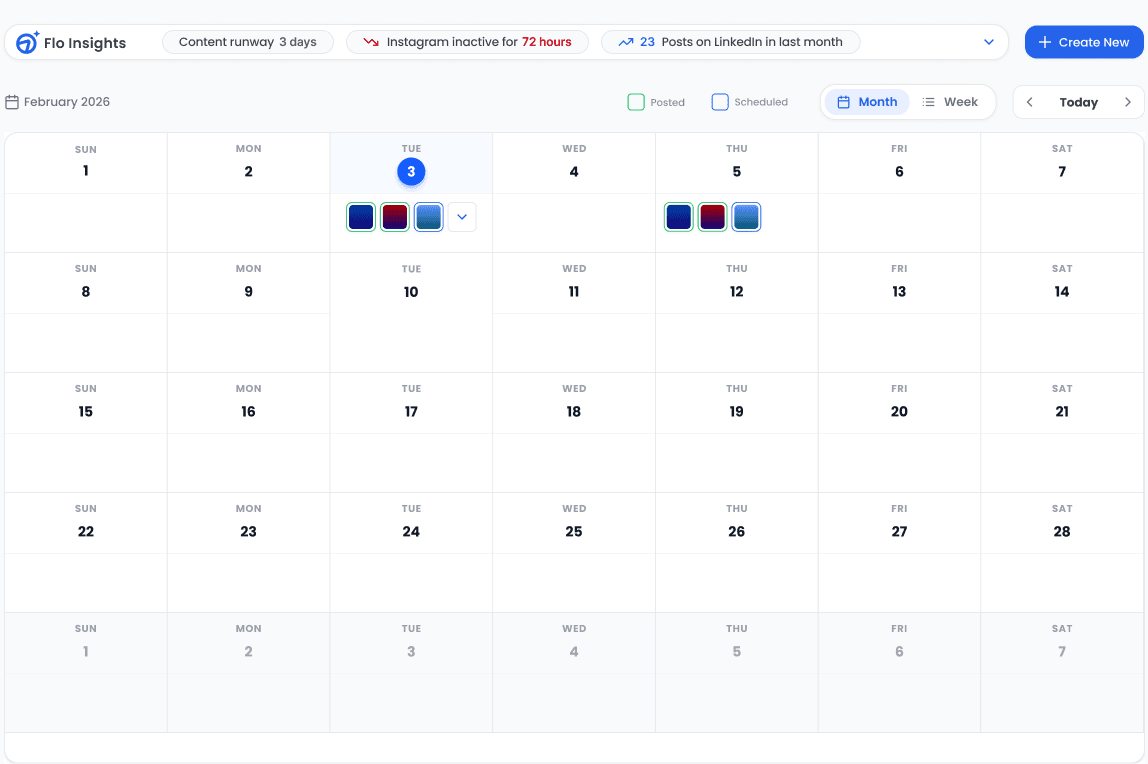
Integrating the Calendar as a Consequence, Not a Tool

Early calendar explorations placed it as a planning interface.

But users weren’t planners.
They were reactors.

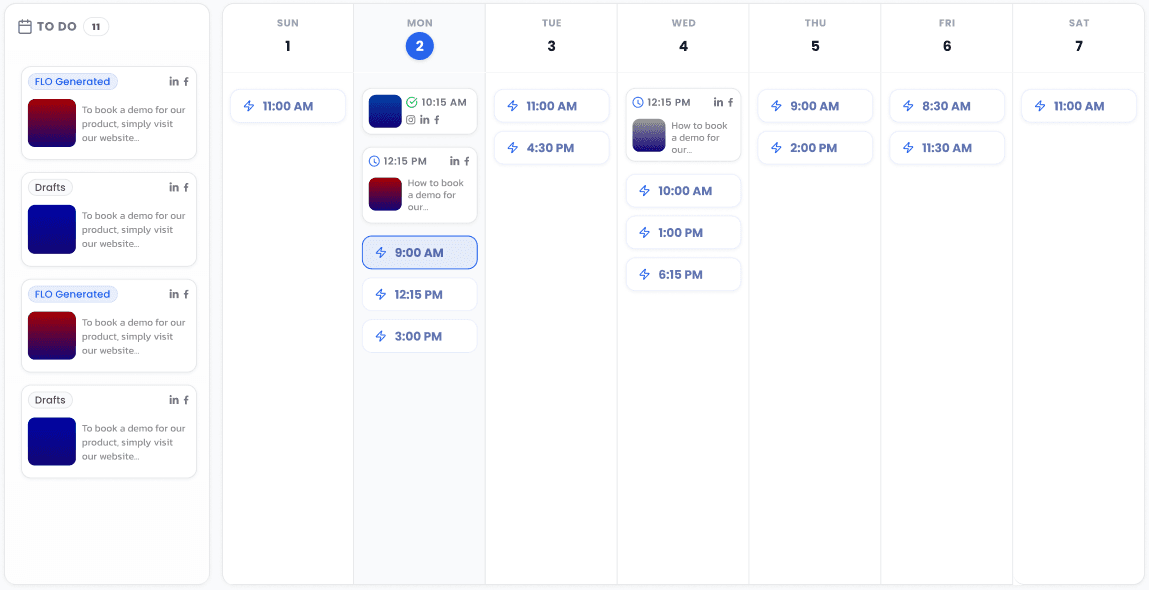
So I repositioned the calendar as a:

  • Confirmation layer.

  • Visibility layer.

  • Consequence of approval.

Instead of dragging posts into dates, Approval auto-filled the calendar.

When users hovered over scheduled days, lightweight previews appeared.
Not a heavy modal.
Just contextual confirmation.

This reinforced momentum rather than interrupting it.

Final Structure: The Content Pipeline

The final system evolved into a clear operational pipeline:

  • Drafted

  • Flo Generated

  • Scheduled

  • Published


But the key difference from early versions:

Flo Generated wasn’t just another column. It was system-prepared work based on operational signals.

Final Designs

The Execution System in Action

The Execution System in Action

After multiple structural explorations, the final design centered around one principle:

Reduce initiation. Increase momentum.

Instead of asking SMBs to plan content, the system prepares it and presents it for decision.

Reflection

Activation is a UX problem.

Activation is a UX problem.

This case study reinforced that AI quality alone doesn’t drive adoption. Behavioral architecture matters more than feature depth. By reducing the cost of starting, we improved consistency without increasing complexity.

MoFlo didn’t just generate content better.
It executed more reliably.